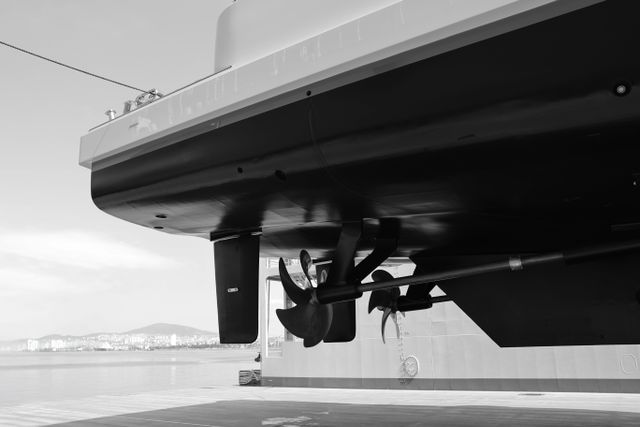
How Stern Tube Bearings Improve Marine Propulsion Longevity
Overhung propeller weight, hydrodynamic wake fluctuations, and shaft bending place intense radial loads on the aft propulsion driveline. Installing properly engineered stern tube bearings supports the tailshaft across both forward and aft housings while dampening rotational vibration before hull seals fail. Matching bearing geometry, lubrication channels, and liner tolerances to vessel duty cycles prevents premature wear and unscheduled dry-docking.
Load Distribution and Alignment Geometry in Stern Tube Bearings
Aft bearing zones absorb the highest bending moments caused by propeller overhang, making shaft alignment and housing geometry critical to uniform pressure distribution. When a tailshaft deflects under thrust, concentrated edge pressure can rapidly degrade bearing surfaces and overheat shaft sleeves.
Balancing Length-to-Diameter Ratios to Prevent Edge Loading
Aft bearing length-to-diameter (L/D) ratios determine how effectively radial loads spread across the lower contact arc. Increasing bearing length lowers unit pressure, yet overly long bushings risk severe edge loading if the shaft bends under changing vessel draft conditions. Classification society guidelines pair optimized L/D ratios with controlled elastic deflection so the bearing conforms to natural shaft curvature.
Controlling Running Clearances for Hydrodynamic Film Formation
Diametral running clearances must allow a continuous lubricating wedge to form between the rotating shaft sleeve and the stationary bearing bore. Engineers calculate exact clearance tolerances by factoring in maximum ambient water temperature, shaft diameter, and polymer moisture-swell characteristics. Proper clearances prevent hydrodynamic film collapse at low speeds without inducing excessive shaft whirl at full power.
Performance Advantages of Water-Lubricated Stern Tube Bearings
Environmental regulations such as the EPA Vessel General Permit and strict port discharge rules have accelerated fleet transitions toward water-lubricated stern tube bearings. Open and closed seawater systems eliminate oil-to-sea leakage risks, remove costly aft face-seal assemblies, and simplify regulatory compliance.
Fluted Stave Channels for Abrasive Silt and Sand Flushing
Vessels operating in shallow coastal waters, estuaries, and inland rivers draw suspended sand and silt directly into the stern tube housing. Axial or spiral water grooves machined between bearing staves create high-velocity flushing channels that sweep abrasive particles out of the load-bearing zone. Continuous flushing prevents third-body abrasion from scoring expensive bronze or stainless steel shaft liners.
Low-Friction Composite Polymers vs Traditional Elastomer Staves
Modern non-metallic polymers deliver lower dry-start friction and higher load capacity than legacy lignum vitae or standard nitrile rubber formulations. Smooth, low-friction surfaces eliminate stick-slip vibration and audible shaft squeal when vessels maneuver at slow harbor speeds or operate on turning gear.
| Bearing Architecture | Lubrication Medium | Abrasive Particle Tolerance | Low-Speed Friction Behavior | Aft Seal System Complexity |
| Elastomeric Polymer Staves | Open or closed seawater | High, traps and flushes grit through longitudinal grooves | Low friction once water film establishes; resilient to shock | Simple forward stuffing box or lip seal; no aft oil seal |
| Fiber-Reinforced Composite Bushings | Open or closed seawater | Moderate to high with axial cooling flutes | Very low dry-start friction; eliminates stick-slip chatter | Simple forward shaft seal; eliminates marine oil pollution risk |
| White Metal Babbitt Bearings | Pressurized mineral or synthetic oil | Low, requires strict closed-loop filtration | Dependent on continuous hydrodynamic oil pressure | Complex multi-lip aft and forward seals with header tanks |
Maintenance Practices That Preserve Stern Tube Bearings Between Dry-Docks
Even high-capacity stern tube bearings degrade prematurely if cooling water flow drops or shaft liners develop localized corrosion. Disciplined condition monitoring during routine port calls catches progressive wear before emergency dry-docking becomes unavoidable.
Monitoring Flow Rates, Filtration, and Differential Pressure
Closed and semi-closed water-lubricated systems rely on dedicated supply pumps, duplex strainers, and flow switches to maintain uninterrupted cooling volume. Operators should verify flow indicators before engine start-up and clean strainer baskets immediately after transiting silt-heavy channels. Maintaining positive water pressure inside the stern tube also blocks external sediment from migrating inward through the aft rope guard.
Installation Tolerances for Retrofit and Newbuild Stern Tube Bearings
Precise housing preparation determines whether replacement stern tube bearings achieve full design service life after a shipyard overhaul. Out-of-round stern tube bores or rough shaft sleeves create uneven contact patches that accelerate wear within the first few hundred operating hours.
Interference Press Fits, Freeze Fitting, and Keyed Stave Retention
Full-form composite bushings typically require controlled interference fits achieved by chilling the bearing in liquid nitrogen or dry ice prior to sliding it into the housing. Stave-type bearings instead rely on machined dovetail grooves or bolted bronze keeper bars that allow individual worn staves to be replaced without pulling the tailshaft.
Surface Finish Standards for Propeller Shaft Sleeves
Propeller shaft liners must be machined and polished to a smooth surface roughness, typically between 0.4 and 0.8 micrometers Ra, before installation. Inspecting bronze, stainless steel, or nickel-chromium-boron weld overlays for pitting and runout ensures the rotating journal polishes rather than abrades the mating bearing bore.
Extending marine propulsion service life requires aligning bearing load geometry, flushing groove design, and shaft sleeve tolerances with actual vessel operating conditions. Transitioning to water-lubricated stern tube bearings removes oil-seal failure points while providing strong resistance against coastal sediment wear.
Combining accurate shipyard alignment with consistent cooling-flow monitoring and poker-gauge logging keeps tailshafts running smoothly across multi-year survey cycles. Selecting durable bearing architectures and verifying installation clearances protects critical driveline components from avoidable downtime.